
Reflections on the entry into force of the BBNJ Treaty
The formal adoption of the BBNJ Treaty on 17 January, and its subsequent entry into force, mark a long-awaited milestone in international ocean governance. For the International Ocean Institute, this moment represents not an end point, but the consolidation of decades of collective effort to strengthen the governance of the ocean beyond national jurisdiction.
The path to this treaty has been neither linear nor uncomplicated. It has unfolded through years of multilateral dialogue, technical debate, political compromise, and sustained engagement across institutions and regions. Throughout this journey, IOI has been present at key moments - participating in critical discussions, contributing to capacity development processes, and consistently underlining, through its training programmes, the fundamental importance of safeguarding marine biodiversity in areas beyond national jurisdiction as a shared responsibility of humankind. This approach reflects IOI’s long-standing commitment to the principle of the Common Heritage of Humankind as enshrined in the United Nations Convention on the Law of the Sea.
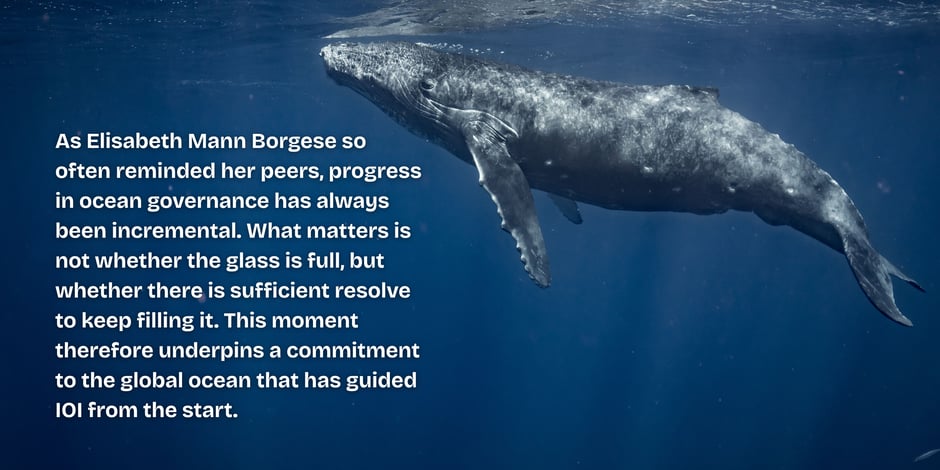
Long before the BBNJ Treaty took shape, this vision was articulated by IOI’s founder, Elisabeth Mann Borgese. At a time when the ocean risked being marginalised within global development debates, she championed the idea of the ocean as a global commons: one requiring cooperative, equitable, and knowledge-based governance beyond national boundaries. Her insistence that informed dialogue, institutional inclusivity, and capacity development were prerequisites for effective governance helped shape the international processes that would later give rise to the BBNJ framework.
The entry into force of the treaty affirms a principle that has always been central to IOI’s mission: that effective ocean governance depends not only on legal instruments, but on ocean literacy, institutional capacity, and the ability to turn shared principles into action. Law alone cannot safeguard the global ocean. Its success depends on how well it is understood, implemented, and sustained - particularly by those tasked with translating global commitments into national and regional practice.
In this sense, the BBNJ Treaty echoes earlier moments in the evolution of ocean governance. As with UNCLOS, it is not a perfect instrument, nor could it be. It is the product of negotiation, compromise, and political reality.
Going forward, the Institute’s work remains firmly focused on what comes next: strengthening capacity, fostering ocean literacy, supporting inclusive governance processes, and empowering present and future ocean leaders to carry this treaty into effective implementation.